Showing posts with label pharisees. Show all posts

Wednesday, November 23, 2022

Pharisee Virus

Mark 8:11-15, CEB - The Pharisees showed up and began to argue with Jesus. To test him, they asked for a sign from heaven.  With an impatient sigh, Jesus said, “Why does this generation look for a sign? I assure you that no sign will be given to it.”  Leaving them, he got back in the boat and crossed to the other side of the lake.

Jesus’ disciples had forgotten to bring any bread, so they had only one loaf with them in the boat.  He gave them strict orders: “Watch out and be on your guard for the yeast of the Pharisees as well as the yeast of Herod.”


Mainstream Christian theology asserts that Jesus was at the same time fully human AND fully divine.  Millions of pages have been written attempting to explain this paradoxical concept, but ultimately, it is best to work to accept it on faith.  Unless Jesus is fully human, He cannot fully bridge the gap between us and God; unless Jesus is fully God, He cannot save us.  Much of the miracles described in the gospels point to the divinity of Christ, but in the passage above we catch a glimpse of Jesus’s humanity.  Mark recalls Jesus’s “impatient sigh.”  Jesus is finding it hard to remain composed in the presence of the impetuous Pharisees.   

Most of us have been there and understand that kind of exasperation.  Someone or a group of someone’s questions our right to be doing what we are doing.  They ask us to prove ourselves even though they have already seen proof.  It seems they are being confrontational simply to tear us down.  We recognize that impatient sigh because it has rushed from our mouths on multiple occasions.

“No sign will be given,” follows Jesus’s sigh. 

Jesus refuses to play their game for He knows that it is a losing proposition.  If a sign was given, it would only be followed up with a request for a further sign.  Signs do not result in authentic faith in those who receive them.  They only placate until a desire for another sign arises. It is faux faith at best.  It is unhealthy dependence on constant “proof” that our trust in God is justified. 

I believe this is one of the reasons Jesus often tells those He has healed to not talk about it too much. Even miracles do not produce a healthy faith.  The high experienced when one witnesses the miraculous is short-lived.  It will take another miracle to sustain it.  Right before this passage in Mark 8, the disciples clearly don’t have faith in Jesus’s ability to provide food for the four thousand even though they witnessed Jesus feed five thousand just days earlier.  They too needed proof that Jesus could do it again. 

The yeast of the Pharisees is this constant questioning and demand for proof.  This is the basis for Jesus’s scolding of his disciples to avoid this yeast.  When Jesus includes “Herod” as part of this yeast, He is referring to the Sadducees, another group of religious leaders who were constantly testing Jesus in the same way.  They were often called Herodians because they supported Herod Antipas.  Jesus refers to them as “Herod” to imply that they were no different than the oppressive ruler himself. 

What Jesus is implying by referring to the Pharisees and Sadducees as yeast is somewhat lost on many modern readers who aren’t bakers.  Yeast is used by bakers to cause dough to rise and expand.  A miniscule amount of yeast is needed to infiltrate the entire loaf and make it grow exponentially. What Jesus is saying is that faux faith quickly spreads.  A particularly current metaphor that could convey the same meaning is to call this imposter faith a virus. 

As we’ll see in the next reflection, the disciples are still not getting the message.  Mark is hoping that, by telling the story, the reader will get it.  Strive for a faith deeper than “faith” that requires constant proof.  Authentic faith in Jesus based on a relationship with Jesus Himself serves as “a vaccine” to protect against this Pharisaical virus. 

This is still true today, although the “virus” has many variants.  Faith that requires answered prayers (defined as getting what I want), success, or any other condition to be met for that faith to be sustained.  The invitation offered to the disciples and to us is to trust that God will give us what we need when we need it.  It is the invitation to trust Jesus’s shepherd-like compassion for us, knowing he will provide for us.  This is hard and all of us seem to catch the Pharisaical virus sometimes. Hence, Jesus issues the warning to watch out and guard against it. 


Question:  Have you ever caught yourself placing conditions (ie…seeking a sign) on sustained faith in Jesus?


Prayer:  Spirit lead me where my trust is without borders. Let me walk upon the waters wherever You would call me. Take me deeper than my feet could ever wander and my faith will be made stronger in the presence of my Saviour.  Amen.


Prayer Focus:  Pray for people who will be alone on Thanksgiving tomorrow. 


Song:  Oceans – Hillsong United (Cover by Hannah Davis)

https://www.youtube.com/watch?v=s-Q1WuWpulY


Wednesday, November 16, 2022

They Regretted Asking Jesus This Question

Mark 7:1-23, CEB - The Pharisees and some of the teachers of the law who had come from Jerusalem gathered around Jesus and saw some of his disciples eating food with hands that were defiled, that is, unwashed.  (The Pharisees and all the Jews do not eat unless they give their hands a ceremonial washing, holding to the tradition of the elders.  When they come from the marketplace they do not eat unless they wash. And they observe many other traditions, such as the washing of cups, pitchers and kettles.)

So the Pharisees and teachers of the law asked Jesus, “Why don’t your disciples live according to the tradition of the elders instead of eating their food with defiled hands?”

 He replied, “Isaiah was right when he prophesied about you hypocrites; as it is written:


“‘These people honor me with their lips,

    but their hearts are far from me.

 They worship me in vain;

    their teachings are merely human rules.’

You have let go of the commands of God and are holding on to human traditions.”

And he continued, “You have a fine way of setting aside the commands of God in order to observe your own traditions!  For Moses said, ‘Honor your father and mother,’ and, ‘Anyone who curses their father or mother is to be put to death.’ But you say that if anyone declares that what might have been used to help their father or mother is Corban (that is, devoted to God)—  then you no longer let them do anything for their father or mother.  Thus you nullify the word of God by your tradition that you have handed down. And you do many things like that.”

Again Jesus called the crowd to him and said, “Listen to me, everyone, and understand this.  Nothing outside a person can defile them by going into them. Rather, it is what comes out of a person that defiles them.”

After he had left the crowd and entered the house, his disciples asked him about this parable. “Are you so dull?” he asked. “Don’t you see that nothing that enters a person from the outside can defile them?  For it doesn’t go into their heart but into their stomach, and then out of the body.” (In saying this, Jesus declared all foods clean.)

He went on: “What comes out of a person is what defiles them.  For it is from within, out of a person’s heart, that evil thoughts come—sexual immorality, theft, murder,  adultery, greed, malice, deceit, lewdness, envy, slander, arrogance and folly.  All these evils come from inside and defile a person.”


Questions:  Do you have rules and/or traditions that you follow without question that you have no knowledge of the purpose or origin of said rules/traditions?  Are you aware of established laws and/or customs that once served an important purpose, but now actually fulfill a purpose contrary to the original purpose?


  We start with the questions today because it lies at the heart of this conflict between Jesus and the pharisees.  The pharisees notice that Jesus’s disciples are eating without properly washing their hands.  This is a violation of dietary laws and is considered to make someone physically and spiritually unclean.  The pharisees are calling out Jesus for allowing his disciples to commit this violation.  Jesus’s answer and explanation points out that the pharisees are not technically wrong, but they are wrong nonetheless. 

  The laws that the disciples are breaking were laws originally put in place for public health reasons.  Handwashing is a good idea before you eat even today.  However, the Pharisees had spiritualized these practices.  Instead of pointing out a potentially harmful health hazard, the pharisees were seeking to discredit Jesus morally and spiritually for this violation.  Jesus not only calls them out for calling Him out, He moves toward discrediting them morally and spiritually. 

  The laws given to the Hebrews in the Old Testament had been tweaked and changed over the years to serve not God’s purposes, but the purposes of the pharisees.  They had established loopholes in the God-given laws that allow people to ignore the original laws in favor of the man-created loopholes.  The example Jesus uses concerns one of the ten commandments, which is to “honor your father and mother.”  The pharisees had commissioned a technicality that would allow people to give resources to the Temple that would normally be set aside for taking care of their parents.  As managers of the Temple funds, this pharisees benefitted.  In this way they effectually legitimized the breaking of one of the core Ten Commandments.  Jesus says this is just one example of the corruption for which the pharisees are responsible.  Unlike Jesus disciples, the pharisees ARE morally and spiritually compromised. 

  Then, Jesus uses the occasion to give what would have been a revolutionary teaching. People are not spiritually/morally compromised by what goes into their bodies; they are compromised by the deeds that flow out of their corrupted hearts.  Handwashing might be a good idea, but failing to do it doesn’t make you a bad person.  Seeking to discredit a ministry so as to prop up your own does corrupt the people who do such things.  Jesus, without saying it explicitly, is subjugating the dietary laws (and other laws that govern human habits) to the law of love.  All the sins Jesus list at the end of the passage above are all ways that we destroy human relationships.  They are ways in which we betray love.  When we betray love, we betray the very heart of God for God is Love. 

                The manipulation of laws and norms by those in power to benefit themselves to the detriment of others is still a moral and spiritual blight that should be called out for what it is – corruption of God’s intended order.  Institutional systems that create advantages for some and oppression for others still exist and Jesus is still calling them out.   God’s people called the church are not any more immune to this corruption than the pharisees of Jesus’s day.  It is the call of those who seek to live out this teaching of Jesus to find ways to level the playing field for all and encourage all to live by the law of love in all relationships.


Prayer:  Lord, illumine the ways in which we propagate laws and traditions that cause harm and betray Your law of love.  Teach us the heart of your kingdom.  Amen.


Prayer Focus:  If you don’t do this regularly already, spend some time asking God for forgiveness for the specific wrongs in which you have participated.


Song:  Turn My Heart – Lynn De Shazo

https://www.youtube.com/watch?v=_QhJKj4e8o4

Tuesday, October 4, 2022

“Concerning the Sabbath. . . and Way More Than That”

Mark 2:23-3:6 - One Sabbath Jesus was going through the grainfields, and as his disciples walked along, they began to pick some heads of grain. The Pharisees said to him, “Look, why are they doing what is unlawful on the Sabbath?”

He answered, “Have you never read what David did when he and his companions were hungry and in need?  In the days of Abiathar the high priest, he entered the house of God and ate the consecrated bread, which is lawful only for priests to eat. And he also gave some to his companions.”

Then he said to them, “The Sabbath was made for man, not man for the Sabbath. So the Son of Man is Lord even of the Sabbath.”

Another time Jesus went into the synagogue, and a man with a shriveled hand was there.  Some of them were looking for a reason to accuse Jesus, so they watched him closely to see if he would heal him on the Sabbath.  Jesus said to the man with the shriveled hand, “Stand up in front of everyone.”

Then Jesus asked them, “Which is lawful on the Sabbath: to do good or to do evil, to save life or to kill?” But they remained silent.

He looked around at them in anger and, deeply distressed at their stubborn hearts, said to the man, “Stretch out your hand.” He stretched it out, and his hand was completely restored. Then the Pharisees went out and began to plot with the Herodians how they might kill Jesus.


These two Jesus teaching stories that Mark groups together are, of course, about the Sabbath.  But they are also about more than the Sabbath.  Let’s talk about the Sabbath first and move out from there. 

There were many rules/laws governing the Sabbath.  It was to be a regular day of rest where one would refrain from working for a day.  Over the centuries since the Sabbath was a law, hundreds of thousands of pages have been written to further elaborate on the particulars of this day of rest. What constitutes work?  Exactly when does the Sabbath start and end? How do necessary things get done on that day without working?  What if an emergency requires you to work on the Sabbath?  These are just a small fraction of questions covered by the countless volumes of commentary on the fourth of the Ten Commandments. 

Don’t get me wrong; these questions aren’t insignificant.  But it is easy to get so bogged down and distracted by the endless questions about the Sabbath that one can lose sight of the very core purpose of the Sabbath. In the first story above, Jesus points out that this is exactly what has happened.  Jesus and disciples are simply feeding themselves on the Sabbath and what the Pharisees see is that they have violated one of minute interpretations of what constitutes work.   

Jesus points out two problems with this accusatory question.  First, the Sabbath was intended as a lifestyle structure that would benefit the people who followed it, not a law that would require unquestioned obedience to the point of going hungry until the next day.  Building a time of regular rest and renewal into the weekly grind is a healthy practice and part of that practice should include worship of the God who is Lord of All.  To worship is also a healthy practice that benefits those who do it regularly.  Neglecting regular rest and worship has natural consequences that ultimately diminish a person.  But Jesus and his disciples were not neglecting rest and worship.  They were hungry and so they ate. ““The Sabbath was made for man, not man for the Sabbath”

The second problem is pointed out in the second story.  It’s clear that the Pharisees are looking to use the Sabbath rules to actually cause harm to Jesus and His ministry.  They are more concerned about catching Jesus “breaking the rules” than they are about a man being healed of a horrible malady.  Mark doesn’t have to include any commentary here to show how ridiculous it is that the Pharisees are planning to use the healing of a man against Jesus.  The commandment to observe the Sabbath was never to be used to persecute others; that is evil and Jesus slyly suggests that in his rhetorical question. 

If you’ve read any number of my gospel reflections, then you know that my encouragement is to always put ourselves in the place of the Pharisees in these kinds of stories.  It’s much too easy to simply make them the “bad guys.”  When Jesus exposes pharisaical misgivings, He is also exposing universal human tendencies to misunderstand, misuse, and even mistreat others using the very guidance offered by God for our benefit.  I’ve gotten into trouble for breaking a rule in order to help someone, but I’ve also quietly judged others for doing the same.  I, too, have gotten so distracted by the need to find fault in another’s actions that I was willing use a “technicality” to malign someone with good intentions.  I don’t like admitting that I can be like that, but my observation is that most people I have ever know can be like that.  The first step toward becoming better is awareness of the need to be better.


Questions:  In what ways am I guilty of misunderstanding, misusing, and mistreating others with the guidance of God gives me for the benefit of myself and others?


Prayer:  God, show me the things in my spirit that are keeping me from the life you want for me, the life that truly is life. Amen.


Prayer Focus:  Continue to pray for the people in SW Florida, particularly Pine Island and Matlacha.   Pine Island does not get the media coverage that places like Sanibel and Captiva do.  The island will be mostly uninhabitable for at least the next several months.  There are still many people missing and feared dead.  The situation there is dire.  Pray hard.


Song:  Lord, Have Mercy – Michael W. Smith (ft. Amy Grant)

https://www.youtube.com/watch?v=DjPrIVKlvsM

Tuesday, April 5, 2022

Even After He’s Dead. . .


Even After He’s Dead. . .


Mathew 27:62-66, NIV - The next day, the one after Preparation Day, the chief priests and the Pharisees went to Pilate.  “Sir,” they said, “we remember that while he was still alive that deceiver said, ‘After three days I will rise again.’  So give the order for the tomb to be made secure until the third day. Otherwise, his disciples may come and steal the body and tell the people that he has been raised from the dead. This last deception will be worse than the first.”

“Take a guard,” Pilate answered. “Go, make the tomb as secure as you know how.”  So they went and made the tomb secure by putting a seal on the stone and posting the guard.


One thing that good writers do is they try to anticipate the concerns of potential readers as the story is being told.  The writer tries to ask themselves, what are the problems that different kinds of readers will have buying into the story being told.  One of those problems Matthew’s readers will have with buying into the resurrection of Jesus is that it sounds like fiction.  After all, how many resurrections have you personally witnessed? 

For this chasm of skepticism to be bridged, Matthew addresses as least one potential story that could be proposed when readers are confronted with reports of the resurrection; Jesus’s body was stolen and the rest was fabricated.  Ironically, this is the very pretext the religious leaders give for Pilate assigning a guard to the tomb.  They make it impossible to steal Christ’s body by posting Roman guards.  Further, the Roman seal placed on the tomb makes anyone who attempts such a theft an enemy of the state.   I love that the last thing the religious leaders (and Pilate) do in the gospel is to make sure that the account of the resurrection is more believable. Imagine Matthew’s joy in including these seemingly insignificant details in his gospel account.

I have to say that, over the years, God has granted me some compassion for these leaders that seem obsessed with discrediting the Jesus movement.  Putting myself in their shoes, I feel just a bit of the misery and desperation they must have felt.  Thousands had followed this Jesus that criticized the these very religious leaders at every turn.  They were undermined by this rebel and their influence was eroded.  So discrediting Jesus would restore their rightful position and influence.  At least that’s how I imagine the thought process progressing.  What a terrible position to be in – having to tear down someone else in order to feel better about oneself.  I have compassion for these men because I have felt that very sentiment.  It is indeed misery. 

I wish I could say that I am beyond such misery, but I am not.  The impulse to make others smaller so that I, by comparison, feel larger is one that I still encounter often.  It can rob me of being happy for someone getting a promotion that I feel I deserve.   It can keep me from opening up to the possibility that I might be wrong about something because I would have to admit that “that other one” is right.  It can cause me to see someone who might otherwise be a potential friend or ally as a threat and treat them accordingly.  This impulse is so manipulative that it can lead me to believe that a big lie is actually the truth. 

Throughout our journey through Matthew’s gospel, I have encouraged us to adopt the habit of putting ourselves in the place of the “villains” instead of the “heroes.”  There is more potential for our transformation by the gospel when we do that.  If the religious leaders had done that, imagine what could have happened.  But more importantly, imagine what could happen if we did. 


Question:  When was the last time you were able to have authentic compassion for an “adversary?”


Prayer: Just between You and me God, I confess that I struggle to trust that you love me completely regardless of my position compared to others and whether I am right or wrong. Before you, I confess my unhelpful impulses and ask you to forgive me when I have pursued them.  Even more than that, I ask that you replace those dark impulses with compassion for others and for myself.  Amen.


Prayer Focus:  Perhaps a specific “adversary” has popped into your mind as you went through the devo today.  Pray for God to bless that person.


Song:  Pray for Me – Kirk Franklin

https://www.youtube.com/watch?v=mUBwZZSiUzM


Wednesday, February 16, 2022

Now I Have a Question. . .Watch Out!


Now I Have a Question. . .Watch Out!


Matthew 22:41-46, NIV - While the Pharisees were gathered together, Jesus asked them,  “What do you think about the Messiah? Whose son is he?”

“The son of David,” they replied.

He said to them, “How is it then that David, speaking by the Spirit, calls him ‘Lord’? For he says,

“‘The Lord said to my Lord:

    “Sit at my right hand

until I put your enemies

    under your feet.”’

If then David calls him ‘Lord,’ how can he be his son?”  No one could say a word in reply, and from that day on no one dared to ask him any more questions.


For the last few reflections, we have observed different religious groups taking turns trying to stump and discredit Jesus with the crowds in the Temple after Jesus’s arrival in Jerusalem.  In three days time, Jesus will be hanging on a Roman Cross outside the city in part because of the collusion of these very groups.  The questions have been handled brilliantly by Jesus and if fact, have backfired on His questioners.  The crowd is more impressed than ever.  It is the religious leaders who are looking bad about now.

Jesus makes things worse for them when He turns the tables and asks them a question – a question that they will not be able to answer.  As we will see over the next few reflections, this is only the beginning of the misery the religious leaders will endure.  In Matthew 23, Jesus unleashes a torrent of indictments upon them that will fuel their quest to get rid of Jesus.  But for now, let’s consider Jesus’s question:

“What do you think about the Messiah? Whose son is he?”

Jesus knows what they will say because the answer they will give is not wrong.  As expected, they say that the Messiah will be a son of David, meaning that the Messiah will be a human descendant of David.  However, this is only the setup question. 

“How is it then that David, speaking by the Spirit, calls him ‘Lord’?

Jesus then quotes the well-known messianic Psalm 110 to them to support the legitimacy of His question.  Jesus then repeats the question. . . just in case they forgot.  David does indeed address the Messiah as “Lord.”  There is a long silence.  The crowd looks over at the religious leaders, waiting to see how they will answer.  A longer silence.  Crickets.  They don’t even have a guess.  

This is one of those times when the readers of Matthew’s gospel (that includes you and me) have information that the people in the story do not have.  The religious leaders don’t have an answer for Jesus’s question and neither does the crowd.  At this point in the story, even Matthew himself doesn’t have the answer, for He writes this Gospel that we are reading decades later.  But we know the answer, don’t we?

Jesus is a Son of David.  Matthew established that in Chapter 1 with the genealogy of Jesus.  We also know that Jesus is the Son of God, for that has been established multiple times in the Gospel though Jesus often tells folks to hold that under wraps.  If Jesus is a son of David AND the Son of God, then David can address Him as Lord.  We know that and Matthew lets us enjoy the fact that the people who should know better than anyone else do NOT know.  Jesus is now going public with the secret He asked people to keep until now – the secret that we already know.  Jesus is Lord and Messiah because he is both the human son of David AND the divine Son of God. 

The real question for us is not whether we know the answer to Jesus’s riddle, but do we sincerely believe the answer is true?  And if the answer to that question is “yes,” then there is an even more poignant question:  How then, shall we live?


Question:  If you believe Jesus is the divine Son of God and the promised Messiah of all people, how does the way you live reflect that belief?


Prayer:  Jesus, thank you for revealing Yourself to us.  Help us represent You to others by the way we live each day.  Amen.


Prayer Focus:  Pray for people you know from other faith traditions than yours.

Song:  Build My Life - Michael W Smith

https://www.youtube.com/watch?v=7jYMEJ0QNcw

Friday, February 11, 2022

Between Death and Taxes

Between Death and Taxes


Matthew 22:15-22, NLT - Then the Pharisees met together to plot how to trap Jesus into saying something for which he could be arrested.  They sent some of their disciples, along with the supporters of Herod, to meet with him. “Teacher,” they said, “we know how honest you are. You teach the way of God truthfully. You are impartial and don’t play favorites.  Now tell us what you think about this: Is it right to pay taxes to Caesar or not?”

But Jesus knew their evil motives. “You hypocrites!” he said. “Why are you trying to trap me?  Here, show me the coin used for the tax.” When they handed him a Roman coin, he asked, “Whose picture and title are stamped on it?”

“Caesar’s,” they replied.

“Well, then,” he said, “give to Caesar what belongs to Caesar, and give to God what belongs to God.”

His reply amazed them, and they went away.


                Can you sense the irony here?  The Pharisees are brainstorming a way to get Jesus arrested and/or killed.  So they send their minions to approach Jesus with this ploy.  Say to Jesus, “we know you are a pull-no-punches-kinda guy; we know you’ll be completely honest with us.”  Then they ask Jesus about paying the extremely unpopular Roman tax.  They expect Jesus to speak publicly about not paying the tax, which will get Him arrested.  In other words, they dishonestly go to Jesus asking Him to be honest. 

                It doesn’t take supernatural power to see through this.  I’m sure each of us have had the experience of knowing beforehand when someone is being less than straightforward with us.  Jesus sees this for the trap that it is and so, he sidesteps it. Many scholarly interpreters read some politics at play here in Jesus’s response.  I usually side with scholars when interpreting the context of scripture, but in this case, I’m not convinced.  I don’t think Jesus was trying to make a blanket statement about whether Christians should acknowledge and respect secular governments.  I believe what Jesus is doing here is simply exposing the hypocrisy of the questioners.  The key for me is that Jesus asks them to produce a coin.  They trap themselves when they produce it.  By producing a Roman coin, they prove that they are Roman collaborators.  There were people who honestly believed that paying taxes to the Romans was sinful.  However, those rebels would not even be caught with Roman money in their possession.  The questioners realize that they have been exposed when Jesus makes the point about who image is on the coin they produced.  When Jesus says, “give to Caesar what is Caesar what is Caesar’s,” he is essentially saying “go do what you were already going to do.”  He even calls them “hypocrites” when He does it. 

                The takeaway for me from this passage is to be aware of own hypocrisy.  The Jewish leaders benefited from many arrangements with the Romans.  Likewise, we often benefit from institutions and cultural practices that we publicly condemn.  I hate the negativity and dishonesty that is rampant on social media, but I continue to participate in social media.  I sincerely believe that broadcast media is mostly infotainment catering to specific market demographics, but I still watch “the news” everyday.  I sometimes complain about taxes, but I benefit from all the infrastructure those taxes fund.  To be fair, some of this is unavoidable.  I can’t avoid driving on government-funded roads if I want to get to church.  I think this is the reality to which Jesus refers.  Right now, we are hopelessly woven into the fabric of earthly kingdoms.  But the invitation is to see that we also belong to God’s Kingdom and that Kingdom will outlast all the others.  There will come a day when “Caesar’s money” will be worthless to us, so you might as well give Caesar his portion now.  It won’t matter whether we are an American citizen or a citizen of Pakistan. The only real question will be, “are we a citizen of Heaven.” The challenge is to keep that in proper perspective.


Question:  Where is one place in your life where you are aware of your own hypocrisy?


Prayer:  God help us see the true allegiances of our hearts.  Point out to us the ways in which we don’t practice what we claim to preach.  Forgive us for our hypocrisy.  Amen.


Prayer Focus:  Pray for people you know that work for the government.


Song: Living Dangerously In The Hands Of God - Steve Camp  

https://www.youtube.com/watch?v=m9Oa0kkq7OU

Friday, January 21, 2022

Jesus’s Position on Divorce


Jesus’s Position on Divorce

January 21, 2022


Matthew 19:1-12, The Message - When Jesus had completed these teachings, he left Galilee and crossed the region of Judea on the other side of the Jordan. Great crowds followed him there, and he healed them.

One day the Pharisees were badgering him: “Is it legal for a man to divorce his wife for any reason?”

He answered, “Haven’t you read in your Bible that the Creator originally made man and woman for each other, male and female? And because of this, a man leaves father and mother and is firmly bonded to his wife, becoming one flesh—no longer two bodies but one. Because God created this organic union of the two sexes, no one should desecrate his art by cutting them apart.”

They shot back in rebuttal, “If that’s so, why did Moses give instructions for divorce papers and divorce procedures?”

Jesus said, “Moses provided for divorce as a concession to your hard heartedness, but it is not part of God’s original plan. I’m holding you to the original plan, and holding you liable for adultery if you divorce your faithful wife and then marry someone else. I make an exception in cases where the spouse has committed adultery.”

Jesus’ disciples objected, “If those are the terms of marriage, we haven’t got a chance. Why get married?”

But Jesus said, “Not everyone is mature enough to live a married life. It requires a certain aptitude and grace. Marriage isn’t for everyone. Some, from birth seemingly, never give marriage a thought. Others never get asked—or accepted. And some decide not to get married for kingdom reasons. But if you’re capable of growing into the largeness of marriage, do it.”


This passage has been widely misinterpreted and because of that, caused much pain for many.  It has been used to condemn all divorces except for sexual immorality.  This is understandable, for reading Jesus’s words at face value, that seems to be what He is teaching.  However, what we are missing is that Jesus wasn’t making a literal prohibition on divorce.  He was stating his position on a widely-known rabbinical debate concerning marriage.  This is clear from the properly translated question that the Pharisees ask Jesus; ““Is it legal for a man to divorce his wife for any reason?”

                The “for any reason” is the key.  A few decades before Jesus’s time, the Rabbi Hillel argued that Deuteronomy 24 permitted a man to divorce his wife for any cause as long as he gave her a certificate of divorce.  The certificate was to protect the woman from her ex-husband ever “reclaiming” her.  But Rabbi Shammai argued that the only ethical reason for a divorce was sexual immorality.  When the Pharisees ask Jesus their question, what they are asking for is His position on the Hillel/Shammai debate. 

                From Jesus’s answer, we see that He sides with Shammai.   However, what is not commented on at all in this exchange is the larger Jewish framework of marriage that is already in place.  To summarize that framework, it basically stated that the obligation of marriage is to provide three things:

(1) Fidelity – no adultery

(2) Provision – the spouse is to be provided for

(3) Love – the spouse is not to withdraw or withhold love (sexual or otherwise)

The divorce that Moses permitted in Deuteronomy 24 was permitted for a failure to provide any of those three things.  If a spouse was unfaithful, did not provide for you, or basically abandoned the relationship, divorce was permissible.  Jesus, the Apostle Paul, and Shammai would have all said that as well. 

                The Pharisees did not like Jesus’s answer because the “for any cause” divorce had become popular by Jesus’s time.  Jesus is trying to remind them of God’s original plan for marriage which was “the two become one” and “what God has put together, let no one tear apart.”  Jesus’s disciples were obviously not thrilled with Jesus’s answer either for they complain that his position is too hard.  They protest, “then why get married?” 

                Jesus affirms that their question is a good one…a question that everyone considering marriage should answer from a deep place in their heart.  Marriage is a serious covenant and because of that, it’s not for everyone.  If one can’t live up to the above promises, it would be better for them to remain single.  The Apostle Paul says this even more explicitly.

Divorce, in almost every circumstance, is painful.  But sometimes, divorce is necessary to prevent even more pain when one or both spouses can’t or won’t live up to the promises.  When this happens, the community of faith should work to support those who have experienced this regrettable pain, not shun or stigmatize them. 

In Malachi 2:16, scripture states that, “God hates divorce.”  While this passage is often quoted to condemn divorce, it totally disregards the reason behind the statement.  In Jeremiah 3:8, God says through the prophet, “I gave faithless Israel her certificate of divorce and sent her away because of all her adulteries.”  God hates divorce because God has been through it.  The covenant God made with Israel was broken by Israel and God allowed Israel to go her way.  This was why a new covenant was needed . . .a covenant God establishes through Jesus Himself.  One of the primary images of that covenant is marriage; the church is the “Bride of Christ.”  Fidelity, provision, and love are still the core promises of this relationship.  God has never failed to keep those promises even though we sometimes do not. 


Question:  What do you understand your part to be in your covenant relationship with God?


Prayer:  God, forgive us for the unfaithfulness we have displayed in our relationships with you and others.  Heal our brokenness and strengthen our faith.  Help us to be faithful, provide, and love each other as you do for us. Amen.

Prayer Focus:  Pray for people you know who have been through or are going through a divorce.


Song:  Don’t Let Your Heart Be Hardened – Petra

https://www.youtube.com/watch?v=QWNh1IyFdvM

Saturday, November 20, 2021

Matthew 16:1-12 - Watch Out for That Yeast!


Watch Out for That Yeast! - November 20, 2021

Matthew 16:1-12, The Message - Some Pharisees and Sadducees badgered him again, pressing him to prove himself to them. He told them, “You have a saying that goes, ‘Red sky at night, sailor’s delight; red sky at morning, sailors take warning.’ You find it easy enough to forecast the weather—why can’t you read the signs of the times? An evil and wanton generation is always wanting signs and wonders. The only sign you’ll get is the Jonah sign.” Then he spun around and walked away.

On their way to the other side of the lake, the disciples discovered they had forgotten to bring along bread. In the meantime, Jesus said to them, “Keep a sharp eye out for Pharisee-Sadducee yeast.”

Thinking he was scolding them for forgetting bread, they discussed in whispers what to do. Jesus knew what they were doing and said, “Why all these worried whispers about forgetting the bread? Baby believers! Haven’t you caught on yet? Don’t you remember the five loaves of bread and the five thousand people, and how many baskets of fragments you picked up? Or the seven loaves that fed four thousand, and how many baskets of leftovers you collected? Haven’t you realized yet that bread isn’t the problem? The problem is yeast, Pharisee-Sadducee yeast.” Then they got it: that he wasn’t concerned about eating, but teaching—the Pharisee-Sadducee kind of teaching.


                Back when we were in Matthew 12, we hear Jesus having almost the same encounter with the Pharisees – the Pharisees asking for a sign and Jesus scolding them.  He tells them again that “the only sign you’ll get is the Jonah sign.”  Here’s a couple of excerpts from the reflection on Matthew 12:38-45 about what Jesus is suggesting:

                We need to hear Jesus’s warnings to those who should know better, because the warnings are      for us as well.  Don’t continue to demand proof as a basis for faith when all the proof necessary has already been given.  Only people who have already steeled themselves against such proof                and betrayed the faith insist on signs being given.   

                Jesus says that the only sign that will ever be given for such rebels is “the sign of Jonah.”  Jonah   was willingly thrown into the sea by those in peril so that those in peril might be saved from the              wrath all around them.  Long before He is crucified, Jesus alludes to his ultimate sign;  he will die            at the hands of those who oppose Him, but their “victory” is actually their once-and-for-all   defeat.  Truth will prevail in the end.  And the “generation” that fought against truth and             brought others down with them will find themselves in a worse situation than they were in                 before.

Right after this happens for a second time, the disciples forget to bring bread to the next place where they and Jesus will be staying.  Jesus says to them, “Keep a sharp eye out for Pharisee-Sadducee yeast.”

The disciples think Jesus is mad about not having bread. 

                We should note a sad irony here.  First, the disciples have just witnessed Jesus, on two occasions producing enough bread for thousands of people from meager resources.  It is no wonder that Jesus is incredulous at the pure lack of faith that He would be worried about not having enough bread.  “Teaching! Teaching! I’m talking about the faithless teaching of the Pharisees, you dolts!,” is what Jesus seems to be saying.

                The Pharisees are not the only ones missing the signs.  Those closest to Jesus can’t seem to see what has been happening right before their eyes in the time they have been with Jesus.  I find it interesting that Matthew would be completely honest about his own lack of faith in his telling of the story.  He is one of the disciples who are clueless about what Jesus has been trying to tell them for months.  I think Matthew does this because he knows that if the disciples struggled to see what God was doing right in front of them, than his readers will also struggle.  Matthew knows that his struggle is our struggle as well. 

                I am currently reading a book that contends that we humans tend to embrace information as true if we simply hear it enough times or if it already seems to confirm what we already think.  For instance, what would you say if I asked how you calculate a dog’s age equivalent in human years?  Multiply by 7, right?  Unfortunately, there is no science behind this.  It is a saying that has simply been repeated over and over since the 1300’s.  We embrace it as true because we have heard it represented as truth our whole lives.  This is the warning Jesus is making to His disciples (and us).  They have blindly embraced the faithless teaching of the Pharisees and it has caused them to be blind to what is happening right in front of them.  They worry about bread when Jesus has just supernaturally provided bread to thousands multiple times. 

                Sometimes, perhaps even many times, we need to let go of, or at least question, the “truths” that have been represented to us as “truth and nothing but the truth” so much that we can’t see truth right before us. The truth is that God is always doing something right before us, but we often don’t perceive it because we see through “faithless filters.”  You will be provided for by our Savior and any “teaching” that causes you to doubt that, no matter how long you have believed it, should be questioned.  God is not angered by the frivolous mistakes we make; he is saddened by our lack of faith.


Question:  Are there any notions (yeast) that you have always accepted as true that are getting in the way of your trusting God completely?


Prayer:  Lord I believe, help me in my unbelief!  Amen.


Prayer Focus:  Pray for the homeless as we move into the colder months of the year.


Song: Oh Me Of Little Faith - Matthew West

https://www.youtube.com/watch?v=RykT6VN584Y

Wednesday, November 17, 2021

Matthew 15:1-20 - The "Why" Versus the "What"


The "Why" versus the "What" - November 17, 2021

Matthew 15:1-20, CEB - Then Pharisees and legal experts came to Jesus from Jerusalem and said,  “Why are your disciples breaking the elders’ rules handed down to us? They don’t ritually purify their hands by washing before they eat.”

Jesus replied, “Why do you break the command of God by keeping the rules handed down to you?  For God said, Honor your father and your mother, and The person who speaks against father or mother will certainly be put to death. But you say, ‘If you tell your father or mother, “Everything I’m expected to contribute to you I’m giving to God as a gift,”then you don’t have to honor your father.’  So you do away with God’s Law for the sake of the rules that have been handed down to you.  Hypocrites! Isaiah really knew what he was talking about when he prophesied about you,  This people honors me with their lips, but their hearts are far away from me.  Their worship of me is empty since they teach instructions that are human rules.”

Jesus called the crowd near and said to them, “Listen and understand.  It’s not what goes into the mouth that contaminates a person in God’s sight. It’s what comes out of the mouth that contaminates the person.”

Then the disciples came and said to him, “Do you know that the Pharisees were offended by what you just said?”

Jesus replied, “Every plant that my heavenly Father didn’t plant will be pulled up.  Leave the Pharisees alone. They are blind people who are guides to blind people. But if a blind person leads another blind person, they will both fall into a ditch.”

Then Peter spoke up, “Explain this riddle to us.”

Jesus said, “Don’t you understand yet?  Don’t you know that everything that goes into the mouth enters the stomach and goes out into the sewer?  But what goes out of the mouth comes from the heart. And that’s what contaminates a person in God’s sight.  Out of the heart come evil thoughts, murders, adultery, sexual sins, thefts, false testimonies, and insults.  These contaminate a person in God’s sight. But eating without washing hands doesn’t contaminate in God’s sight.”


Did you know, that in Little Rock, Arkansas, it’s against the law to honk your horn near a sandwich shop after 9pm?  Did you know that in Rehobeth, Delaware, it’s illegal to whisper in church?  In Gainesville, Georgia, it’s illegal to eat fried chicken with a knife and a folk.  In Rockville, Maryland, you can be fined $100 for swearing in public?  I could on and on, but you already read a long scripture, so I’ll get to the point.  Humans are notoriously silly sometimes when it comes to making rules. . . probably a bit more than sometimes if I’m honest.

                The Pharisees were trying to call out Jesus and his disciples for not washing their hands properly (Pharisee-created rules) before a meal, but I’m guessing they regretted doing that because of what happened next.  Jesus calls them out not for breaking Pharisaical law, but God’s command to honor your Father and Mother.  They had created their own exceptions to this commandment (one of the big Ten Commandments I might add) that actually used God as the workaround.  They stipulated that you could forgo giving the expected contributions to parents if you gave it to God instead.  By “God,” the Pharisees meant the Temple, an institution they controlled.  Jesus rightly expresses outrage for using God to disrespect parents. 

                Most rules, laws, and traditions were implemented for a good purpose.  Even the humorous laws above were made to try and solve a problem.  But so many times, the original purpose is lost and the rule/law/tradition is co-opted by authorities to exert their own control and/or serve their own purposes.  The people of God are not immune to this tendency.  In fact, it is a huge problem even today among church institutions and congregations.  Churches split over the color of the carpet.  Our Bishop tells the story of how, as a kid, he and his mom were shunned by their congreation because his mom got a divorce.  Decisions by denominational boards and agencies are all too often made, not with the benefit of local congregations in mind, but to preserve the institution at all cost.  I sincerely believe that Jesus’s criticism of what is happening now would be even harsher than the words he leveled at the Pharisees above. 

                None of us are immune to this.  We follow rules and/or traditions simply because they are rules and/or traditions.  My encouragement here is not to be a rebel and start breaking all the rules/tradtions, but to start thinking about why the rules/traditions exist.  The “why” we do things matter to God more than following the letter of the law keeping a purposeless tradition.   Loving God and people should guide all that we do, whether the laws/rules/traditions require it or not.   If we all loved God and people properly, no other rules would be necessary. 


Questions:  Have you ever used a rule to gain an advantage over someone?  Have you ever used a tradition as an excuse to not do what you know God wanted you to do?


Prayer:  God, in the life and teachings of Jesus, You have shown us your heart.  Help us to follow Your Heart above all else.  Point out any hypocrisies in our behavior towards You and others. Help us to do better. Amen.


Prayer Focus:  Talk to God today about the condition of your heart.  


Song: Let’s Work Together – Canned Heat 

https://www.youtube.com/watch?v=143A1aUG-9I

Tuesday, October 26, 2021

Matthew 12:38-45 - The Sign of Jonah


Daily Devo w/ Pastor Eric October 26, 2021

The “Sign of Jonah”


Matthew 12:38-45, NLT - One day some teachers of religious law and Pharisees came to Jesus and said, “Teacher, we want you to show us a miraculous sign to prove your authority.”

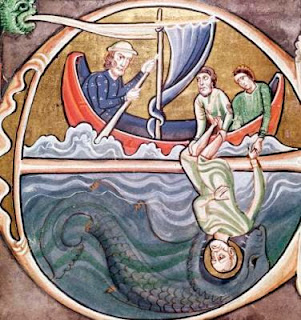
But Jesus replied, “Only an evil, adulterous generation would demand a miraculous sign; but the only sign I will give them is the sign of the prophet Jonah.  For as Jonah was in the belly of the great fish for three days and three nights, so will the Son of Man be in the heart of the earth for three days and three nights.

“The people of Nineveh will stand up against this generation on judgment day and condemn it, for they repented of their sins at the preaching of Jonah. Now someone greater than Jonah is here—but you refuse to repent.  The queen of Sheba will also stand up against this generation on judgment day and condemn it, for she came from a distant land to hear the wisdom of Solomon. Now someone greater than Solomon is here—but you refuse to listen.

“When an evil spirit leaves a person, it goes into the desert, seeking rest but finding none.  Then it says, ‘I will return to the person I came from.’ So it returns and finds its former home empty, swept, and in order.  Then the spirit finds seven other spirits more evil than itself, and they all enter the person and live there. And so that person is worse off than before. That will be the experience of this evil generation.”


We rejoin the spirted conversation between Jesus and the Pharisees/religious teachers.  After being warned by Jesus that they are teetering on the edge of sin that is unforgivable, the leaders ask Jesus for a sign to prove he has authority to say such harsh things to them.  Remember, they have witnessed several “signs” already, including demon-exorcisms, countless healings, and even a resurrection or two.  So Jesus, who isn’t a show-us-a-miracle traveling road show, refuses to perform on-demand for the leaders who will no more be swayed from their murderous intent than they have been up until now.  Instead, Jesus’s critique of them continues.

“Only an evil, adulterous generation would demand a miraculous sign; but the only sign I will give them is the sign of the prophet Jonah.”(v. 39)

Once again, Jesus stops short of actually calling the leaders evil and adulterous, but He might as well have.  But as I have encouraged us to do before, let’s not distance ourselves from the targets of Jesus’s polemic here.  We need to hear Jesus’s warnings to those who should know better, because the warnings are for us as well.  Don’t continue to demand proof as a basis for faith when all the proof necessary has already been given.  Only people who have already steeled themselves against such proof and betrayed the faith insist on signs being given.    

                Jesus is angry and one of the words he uses here helps us understand why – generation (“only and evil, adulterous generation…”).  Jesus is making a charge against specific individuals; he’s leveling an evaluation of an entire generation.  Implied here is the troubling thought that, not only have these leaders turned against the God they claim to serve, they are leading and will continue to lead others to do the same.  Jesus is not just calling out evil. He is calling out systemic evil.  When Nineveh was called out by Jonah, they repented.  When the Queen of Sheba heard about the wisdom of Solomon, she traveled across the world to hear it personally.  But now, God-in-the-flesh is standing before these leaders and they continue to demand proof and cast doubts into the hearts of their followers.  Shame, shame.

                This grave warning still calls out all who persist in setting themselves against obvious truth and leading others to do the same.  Jesus says that the only sign that will ever be given for such rebels is “the sign of Jonah.”  Jonah was willingly thrown into the sea by those in peril so that those in peril might be saved from the wrath all around them.  Long before He is crucified, Jesus alludes to his ultimate sign;  he will die at the hands of those who oppose Him, but their “victory” is actually their once-and-for-all defeat.  Truth will prevail in the end.  And the “generation” that fought against truth and brought others down with them will find themselves in a worse situation than they were in before.

                It’s extremely hard to resist the temptation to conclude that Jesus’s warning is not for us.  But every generation recorded in the Bible and all the generations since the last word of the Bible was scribbled down have struggled with embracing the obvious signs they have already been given in favor of looking for a sign that will never come.  I already have all the “proof” I will ever need that I should follow Jesus with all that I have.  You have that proof as well.  This leads to a very uncomfortable question.


Question:  Why do we continue to resist truth we already know deep in our hearts is right? 


Prayer:  Have mercy on us Lord when we refuse to receive the truth You offer – the truth that could set us free.  Help us let go of our resistance even when it is so hard to do so, lest we become part of a generation that stands on the wrong side of Your warning.  Amen.


Prayer Focus:  Pray for the healing of divisions within the worldwide church. 


Song:  Come Tear Down the Walls/I Surrender All - Revere

https://youtu.be/pJhvXhA2CxU?t=103

Monday, October 25, 2021

Matthew 12:30-37 - The Unforgivable Sin?


Daily Devo w/ Pastor Eric October 25, 2021

The Unforgivable Sin?


Matthew 12:30-37, NIV - “Whoever is not with me is against me, and whoever does not gather with me scatters.  And so I tell you, every kind of sin and slander can be forgiven, but blasphemy against the Spirit will not be forgiven.  Anyone who speaks a word against the Son of Man will be forgiven, but anyone who speaks against the Holy Spirit will not be forgiven, either in this age or in the age to come. “Make a tree good and its fruit will be good, or make a tree bad and its fruit will be bad, for a tree is recognized by its fruit.  You brood of vipers, how can you who are evil say anything good? For the mouth speaks what the heart is full of.  A good man brings good things out of the good stored up in him, and an evil man brings evil things out of the evil stored up in him.  But I tell you that everyone will have to give account on the day of judgment for every empty word they have spoken.  For by your words you will be acquitted, and by your words you will be condemned.”


As a pastor, I’ve gotten more questions about the “unforgivable sin” than anything else.  Of course, we would naturally worry about something we could do to cause God to “write us off” permanently.  So it is important to gain some clarity about what Jesus is suggesting here is unforgivable.

  The first thing we need to note is who Jesus is talking to here – the murderous pharisees.  As we talked about last time, the pharisees are so angry at Jesus that they have begun to look at everything He says and does as a possible reason to have Him killed.  He has just cast out a demon and healed a man and the pharisees make the ridiculous accusation that Jesus has cast out a demon by the power of demons.  Jesus rightly points out that the pharisees have witnessed demon exorcisms before and they never attributed such miracles to demonic power before – He is exposing their accusations as being motivated by something other than truth.  And then he utters a very pointed warning that has caused untold millions to wonder about the unforgivable sin:

“Anyone who speaks a word against the Son of Man will be forgiven, but anyone who speaks against the Holy Spirit will not be forgiven, either in this age or in the age to come.” (v. 32)

It is crucial to note here that Jesus is issuing a warning here, not an indictment.  Jesus doesn’t say that the religious teachers have committed the unpardonable sin, but he is alerting Holy Spirtiuthem that they are right on the edge.  They can hate on Jesus all they want, but when they let their anger carry them away so far that they begin attributing the work of the Holy Spirit to the Prince of Demons, they will have gone too far.  It not so much that God has turned away from such offenders as the offenders have permanently turned their back on God.  To receive God’s forgiveness, one has to want it in the first place.  Jesus is teaching us here that people who attribute God’s power to the Devil don’t want forgiveness and further, God will not forgive someone against their wishes.  

                If you are one who even cares in the slightest that there is something God will not forgive, you are, by definition, NOT someone who could commit that which is unforgiveable.  What I would suggest we take away from this exchange between Jesus and the pharisees is not the unforgivable sin, but the larger point that Jesus is making.  Jesus states this point plainly at the end of the exchange:

“Make a tree good and its fruit will be good, or make a tree bad and its fruit will be bad, for a tree is recognized by its fruit.  You brood of vipers, how can you who are evil say anything good? For the mouth speaks what the heart is full of.  A good man brings good things out of the good stored up in him, and an evil man brings evil things out of the evil stored up in him.” (v. 33-35)

When you focus your life on bad things (like looking for a pretext to kill someone), the eventual result of such a focus makes you a “bad tree.”  When you focus on producing good things, the opposite happens; a “good tree” is the result.  When you store up anger and rage, you literally ruin yourself from the inside out; the resulting toxicity can’t help but come out.  When you store away goodness in your soul, it too will be borne out in your actions. 

Question:  When you “take inventory” of your soul, what have you been storing up?


Prayer:  Show us the true motivations of my heart O, God.  Shine light into my darkness that I might turn and focus on your light.  Plant in me the things that make for a “good tree” that produces good fruit.  Amen.


Prayer Focus:   Pray for God to show you one new source of goodness today from which you could begin to focus on. 


Song:   Whatever is True – Vineyard Music

https://www.youtube.com/watch?v=lgC1hWKMBUo